


In response to rising tensions in global trade dynamics, the United States government has imposed new U.S. Tariffs on its various trading partners. In return, the imposed tariffs have caused ripples throughout the foreign economy, with emerging financial platforms feeling the most significant impact in this scenario.
Although many forex market traders generally view tariffs from the perspective of trading operations and geopolitics, their rising impact has become evident on several currency platforms. Moreover, the following implications are majorly visible in the increasing number of forex pairs.
In this article, we will examine how new U.S. tariffs are affecting the rising market forex pairs, while also examining economic fundamentals, capital flows, investor sentiment, and other key factors.
Focusing on The US Tariff Policy
In 2025, the US economy is expected to intensify its protectionist stance by expanding tariffs on a broader range of goods and assets. The following tariffs mainly target several regions and their exports. For instance, you can refer to China, many Southeast Asian nations, and several Latin American countries.
Moreover, the new set of tariffs mainly focuses on protecting domestic organisations and counteracting perceived unfair trading activities. However, in turn, traders, especially in the forex market, can also notice several macroeconomic consequences.
The rising markets, especially those that heavily rely on US exports, are generally facing new pressures. For instance, there are:
- Tariffs on Chinese EVs (Electric Vehicles) and solar panels have negatively impacted China and its trade operators.
- Several Southeast Asian economies, including Malaysia, Thailand, and Vietnam, are significant players in global supply chains. Moreover, the following economies are also noticing the secondary effects of the new U.S. tariffs.
- Various Latin American exporters, such as Mexico and Brazil, have experienced several impacts due to tariffs on different factors. For instance, you can refer to metals, agricultural goods, and machinery.
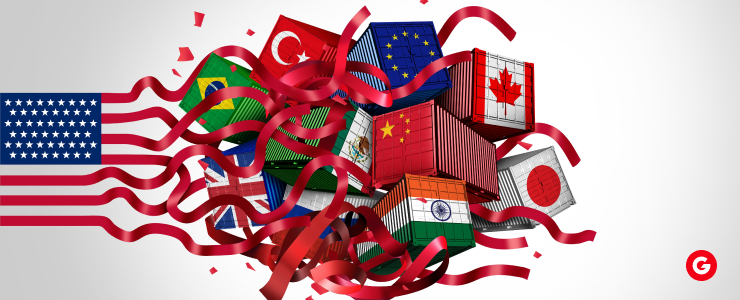
Instant Market Responses: Rising Market Currencies Under Pressure
Following the announcement of the upcoming tariffs, several emerging market currencies have experienced sharp devaluation against the US dollar (USD). Various technical and fundamental factors are responsible for the following reaction, and here are some points you can follow:
Risk-off Sentiment
Investors in CFD trading or the forex market sometimes revert to emerging market goods during times of foreign uncertainty. Additionally, tariff announcements typically increase volatility in the commercial market while also promoting capital flows into different safe-haven assets.
For example, these assets are the Swiss Franc (CHF), Japanese Yen (JPY), and US dollar (USD).
Trading Exposure
Various regions heavily rely on the US trade. For example, several currencies, such as the Malaysian ringgit (MYR), the Thai baht (THB), and the Mexican Peso (MXN), have faced the most significant declines.
Inflation Tension
U.S. tariffs can increase import values and stoke inflation in the emerging markets. Moreover, it can also lead to central banks making difficult policy decisions between regulating inflation and encouraging market growth.
Capital Movement And Carry Trade Dynamics
The U.S. tariffs are indirectly affecting the currencies of emerging markets by altering foreign capital flows. For instance, you can follow these points:
Safety Flights
Foreign investors generally extract capital from emerging markets through trading disputes. Moreover, it primarily occurs due to a fear of instability and reduced expansion in the financial markets. Nonetheless, here are some results you can notice:
- Outflows from emerging market equities and bonds.
- Pressure on local currencies.
- Higher borrowing charges for emerging market governments and organisations.
Affect on Carry Trades
Various emerging market currencies have previously appealed to carry trade investors due to their high yields. For instance, many of these currencies include the Indonesian rupiah (IDR), the South African rand (ZAR), and the Brazilian real.
Nonetheless, the emerging foreign risk aversion and a strengthened dollar value decrease the appeal of such trades. Moreover, it also leads to additional and unwinding currency devaluation.
Central Bank Activities And Commercial Policy Responses
Central banks are currently facing a dilemma in the rising markets. For instance, it raises a question whether central banks should increase their interest rates to assist their currencies or regulate accommodative policies for supporting growth, such as:
- Argentina and Turkey, both countries, are competing against currency volatility and inflation while also aggressively strengthening their commercial policies.
- The Philippines and Indonesia have also indicated caution and focus for forex market interventions rather than sharp rate increases.
- The central bank of Brazil is focusing on balance, as a weakening currency value might stoke inflation, even as expansion remains sensitive.
Moreover, the US Federal Reserve aims to hold high rates to combat inflation rather than attracting capital away from emerging markets.
Market Sentiment And Speculation
Forex market speculators are increasing short-term moves on the platform. Nonetheless, we can also notice several scenarios after the tariff announcements, such as:
- Short positions on emerging market currencies heighten, especially against the yen and the dollar.
- Volatility increases make options in emerging market forex pairs more costly.
- Hedging tactics have become more widespread among organizational investors.
Several factors influence the currency value before the implementation of these policies. For instance, the factors are upcoming tariff expectations, intergovernmental escalation, and retaliatory measures.

In Conclusion
The new set of U.S. tariffs is not just a trading matter but also a currency story. Also, the rising forex pairs are responding concurrently to protectionist evaluations with implications for various sectors and professions. For instance, they are central banks, international corporations, and investors alike.
Additionally, the starting shock is highly negative for emerging market currencies and is associated with in-depth trends in international trade and investment. Moreover, it might also develop new benefits and winners between rising market economies.
Nonetheless, amidst the online trading facilities, our FXGiants platform has emerged as a reliable trading ground for many traders. As we offer various facilities, including stock assets, affiliated programs, and budget-friendly brokers, you can conclude your trading operations with relative ease.
FAQs
1. How can U.S. tariffs impact the forex market?
– The tariffs mainly impact the forex market by making the exchange rates unpredictable on the commercial platforms.
2. Can US tariffs impact the exchange rate?
– The US tariffs impact the exchange rate by affecting home inflation while also regulating the nominal interest rate.
3. How do US tariffs impact the rising market currencies?
– The tariffs affect the emerging market currencies through weakened EM currencies, capital outflows, and higher import charges.
4. Why does the US dollar generally strengthen after the announcement of new tariffs?
– The US dollar generally strengthens after the announcement of new tariffs by extracting finance out of the riskier emerging markets, moving into safe-haven assets, and expecting central banks to raise interest rates.
DISCLAIMER: This information is not considered investment advice or an investment recommendation, but is instead a marketing communication

